
 Just about exactly one year ago the Curiosity Rover had landed successfully on Mars – it was an exciting time and it still is, because the Mars Science Laboratory is still working full time and has made many amazing discoveries on the red planet. Back then, I was still writing mostly in German and posted an article about the landing, which I have translated into English for the anniversary because it’s still entirely valid and captures the excitement of the moment very well:
The Curiosity Rover has made it – this morning, the one-ton Mars truck performed a textbook landing on the red planet! After eight months and 567 million kilometers the new Mars rover arrived safely on the red planet in spite of the breakneck landing maneuver. Only a few minutes after landing the rover sent the first pictures back to earth – still in black-and-white and low resolution, but the landing site is already very well recognizable, if on the first glance unspectacular. But never forget that this is not some shoddy debris field on Earth, but the planet Mars!
I am always glad that I am able to witness such events – it’s not my first Mars rover landing, but every time it gets more exciting and fascinating, especially because the technology has improves so much. Even in 1997 (that was fifteen years ago!) it was possible to follow the landing of Mars Pathfinder on television, but also on the web and it got only better with Spirit and Opportunity in 2004. By now, NASA has really learned how to make a great website and even NASA TV has been watchable over the web for some time in a decent resolution.
But today the NASA is not the only news outlet reporting about their missions, sometimes others do it equally good and often better. The best example are the people from Universe Today, Bad Astronomy & Co, who organized a Virtual Landing Party in the shape of a Google+ Hangout, which is now viewable as a recording on Youtube. Only fifteen years ago this would have been complete science fiction, but now it has become reality – technology makes it possible! The next weeks, months and years are going to be very exciting Mars-wise – not only because of the many fascinating images, which are going to arrive very soon, but also because of the science. The chances that the Mars Science Laboratory is really going to find clues of water or even life are of course 50/50, but even the attempt is worth it!
And if someone asks me now what’s the point of all this, I can only answer with a something I often use: “Where’s your sense of wonder?”
This was one year ago. In the meantime, the Curiosity Rover has found definitive signs that there was flowing water on Mars – it was even established that the rover has landed in a dried-out riverbed. No signs of life, present or past, have been found, but that’s not really what the rover laboratory has been equipped for – it looks for the conditions under which life could have been possible and these have actually been positively identified. Now half the time allocated for the prime mission is over, but the rover is still healthy and there is much to discover on Mars. Even if Curiosity has lost a bit of interest from the media, the mission is still utterly fascinating.
To celebrate the landing anniversary, watch the Virtual Landing Party or yesterday’s Planetary Society Hangout, in which Emily Lakdawalla and Casey Dryer interviewed Curiosity deputy scientist Ashwin Vasavada. [Edit: two more hangouts to watch – Amy Shira Teitel, Scott Lewis, Jason Major and Ian O’Neill look back at Curiosity’s Landing and NASA’s and JPL’s celebration of the anniversary.] Also, my next posting will be an updated link collection to all things Mars.
 Now, what is he blabbering on about now, monkey cages? Well, it’s not my fault that Brian Cox and Robin Ince have called their science-comedy radio series on BBC4 The Infinite Monkey Cage, but since I’ve written about it in a (German-language) article about podcasts before, it’s only logical to mention that the new summer series of six episodes has already begun on Monday and is also available as a podcast on the BBC website.
The radio series has been going on for a few years and most of the back episodes, 37 at the moment are available from the podcast archive. Professor Brian Cox and comedian Robin Ince are talking with their amazing guests about a multitude of scientific themes, but sometimes the discussions end up in a completely different place they started on. It’s fun, it’s interesting and also very educational, but never boring. Advanced English listening skills are of course required, but it’s very much worth it and the half-hour show has just the right length. So hop over to the podcast page, download the new episode or dive into the archives if you haven’t yet!
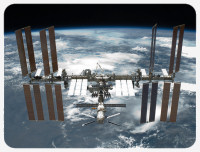 Canadian astronaut Chris Hadfield had been instrumental in bringing human spaceflight back into the limelight, but the phenomenal success of his great outreach work did not please everbody: yesterday there was an article in the German edition of Spiegel Online in which ESA director Thomas Reiter complains about the cult around the International Space Station (English Google-translated version here). He says that too much of the minor and unimportant events like eating, taking photos and making music are thrust into the foreground, while the serious science is being neglected. Reiter stops short of directly criticizing his former colleague Chris Hadfield, with whom he actually played some guitar back in 1995 during a Mir mission as Spiegel Online points out, but his tone is exactly the problem we have here in Germany with everthing science-related: having fun is not allowed, it all has to be serious.
I think Reiter’s comments about Chris Hadfield are not particularly fair, since the Canadian had actually reported a lot about science experiments and the general experience of space flight, always making it clear that it’s not all fun and games on the ISS. There are tons of detailed information available on the web about the science experiments on the ISS, but much of that is of such technical nature that it would be hard to explain to non-scientists – Chris Hadfield had, however, found the right balance between entertainment and seriousness. Calling Hadfields work sensationalism shows that Thomas Reiter might have lost touch with the public – when asked if he would have pursued an “internet career” like Hadfield if the technical capabilities had existed during his time in space, he only answers with a forceful “no”. This reaction is all the more astonishing because Reiter is a veteran astronaut himself, having logged 350 hours in space during two long-duration missions on Mir in 1995 and on the ISS in 2006. He mentions that today’s astronauts have another mentality, but completely ignores that he himself is actually about the same age as Chris Hadfield.
What Reiter is right about is the fixation of the media on the actually rather inconsequential events on the space station, but this is not the fault of the outreach work of the astronauts themselves. But his demand to report only about the serious science is the wrong approach – it’s the fun things of space exploration that will get adults and children interested in science, astronomy and even spaceflight, not the dry and serious science. This is exactly the problem that NASA and ESA have had for a long time – their earlier outreach work has been somewhat dull and only got better in the last few years, but it took an Canadian astronaut to raise even more popularity.
ESA astronaut Luca Parmitano is on the way to become Hadfields successor with his frequent postings on several social networks and he still maintains the same healthy mix of gorgeous photos from orbit, reports about his daily science work and his life in orbit. Yes, there has been some hoopla about ESA’s recently arrived ATV transporter carrying some tasty italian cuisine and that’s another point Thomas Reiter complains about, but the astronauts are not prisoners and their well-being should matter as much as every science experiment. Next year, the German ESA astronaut Alexander Gerst, a civilian scientist, will join the ISS as a crew member – this would be the chance for Germany to step in and do the same great outreach work as Chris Hadfield and Luca Parmitano. The chances are looking good – Gerst has an own website, maintains a Flickr account and is also active on Twitter.
The ISS is not all about science, but also about long-term living in space – while the many scientific experiments are undoubtetly important, we should also not forget that the astronauts are human beings like you and me. Maybe Thomas Reiter has forgotten this.
 Last week, CosmoQuest held a 32-hour Hangout-A-Thon fundraiser and it was a spectacular, fascinating and enormously entertaining event that resulted in more than $23000 in donations. A couple of days before, Pamela Gay and Nicole Gugliucci had asked a group of regular viewers and commentators if they would like to appear in a segment to talk about, amongst other things, how they found CosmoQuest and what they like most about them. Because I don’t have the technical capability to join a hangout at the moment due to slightly too old computers and a slow upstream, I just joined in via the comments and wrote a short post there. I had promised to write a blog posting about my journey to CosmoQuest, but was not able to finish it in time for the hangout. Now I have, but it has become a bit longer than intended and metamorphosized into this article about discovering science and the state of science news and education in general.
Continue reading »
Back in April I wrote about the dire situation the budget sequestration in the USA has created for the amazing citizen science project CosmoQuest. They not only bring much needed science education to American schools, but also run online courses, science projects everyone can participate in and, of course, a whole lot of podcasts and hangouts. Now much of what they do could be in danger of extinction soon because they are funded by a government grant which is going to be cut soon – but they’re not giving up yet!
For this reason, CosmoQuester Pamela Gay and Nicole Gugliucci have decided to hold a fundraiser and do it in their own style: as a 32-Hour Marathon Hangout on Google+! They’re going to have a lot of fantastic guests ranging from scientists to artists to astronomers – there’s also going to be a Virtual Star Party, a live recording of Astronomy Cast and much, much more. Pamela and Nicole both have Google Glass now, so there should be a lot of amazing stuff happening. This is going to be a fantastic event bringing together many fascinating people. [Update 15.06.: See also the video introduction from Pamela Gay, who explains it all much better in only under two minutes!]
The hangout will start on Saturday, June 15th at 12pm EST or 6pm/18:00 CEST and will be split in six parts, which are all linked to on the main event page – there’s also a schedule available which is still in the process of filling up. Everything will, of course, be archived on Youtube as usual, so even if you don’t have time to view it all live (which would admittedly be rather difficult), you can always view the recordings later. All you need to watch is a computer, tablet or smartphone on which you can view Youtube videos and streams on – and a Google+ account if you want to leave comments, because there will be a lot of interaction! If you want to watch on an Android device, see my article from last year on how to watch Google+ Hangouts under Android.
While the Hangout-A-Thon is not a pay-per-view event and watching is free, the whole reason for this amazing event is to raise money for CosmoQuest. So if you like what they are doing and care about science and astronomy education not only in the USA but worldwide, please consider making a donation – I’m sure that even small amounts are going to help and even I am going to send them a little something of $20 or so. I think it’s only fair after having watched so many of their brilliant hangouts!
[Update 17.6: The fundraiser was nothing short of epic and they raised over $20.000, an amazing achievement! Everything has been recorded and is available on Youtube, and donating is, of course, still possible. But… what a ride! :-)]
Note: CosmoQuest logo borrowed without permission, but I’m sure they don’t mind. I’m not affiliated with CosmoQuest, at most I’m an unsolicited volunteer – I just believe in what they do and want to help spread their cause.
 On Wednesday evening, the European Space Agency shot this inconspicuously-looking vehicle into space – it’s the fourth of their space freighters, the Automated Transfer Vehicles, which deliver cargo, fuel and other goods to the International Space Station. Number 4 is called fittingly Albert Einstein and will arrive on the station on June 15th. The night launch from the ESA spaceport in Korou was perfect and the vessel is now in orbit catching up to the ISS – and waiting for another unmanned Progress freighter to leave the station so it can dock.
The ESA has made some amazing videos of the launch available: the Launch Highlights are even more exciting than the live broadcast because more camera angles have been used and there are some words from ESA astronaut and space station inhabitant Luca Parmitano at the end. Even more amazing is the on-board video provided by the experimental Sterex camera built by a German company, not only showing the launch, but also the separation of the stages. You’ve got to hand it to the ESA – their media operations have dramatically improved and the broadcast from the launch and their videos have become even better than those from the NASA.
The launch of ATV-4 would perhaps not gotten any attention in the news, if it wasn’t for the fact that it carries some italian food specialities. Actually, there has been an article with the title Luca’s lasagne on the ESA blog for months now, talking about the problems of food preparation for astronauts. There’s going to be a feast when ATV-4 arrives on the station next week for sure – there’s no publicly available shipping list, but several news articles write about lasagna, risotto, parmesan cheese and tiramisu. Hopefully the freeze-dried versions taste as good as the fresh thing. If there’s one thing that would keep me from traveling to space it’s the food situation!
I also managed a bit of a feat yesterday – I managed to take a photo of the ISS flying over Mülheim just in the moment the ATV was launching from Korou! As usual, in addition to the posting on my own photography blog, I shared the photo on Facebook and Google+ – and on the latter network, to my complete and utter amazement, my photo got re-shared by the ESA in their stream. And it wasn’t even such a great photo, the one from yesterday was much better. But still… wow :-).
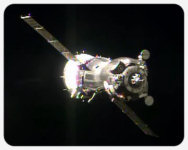 Last night’s Soyuz launch to the ISS with Karen Nyberg, Luca Parmitano and Fyodor Yurchikhin has made a new record, taking only 5 hours and 39 minutes from rocket ignition to the station. It was only the second time the faster launch method has been tried with astronauts on board, but it was a full success and the three new crewmembers did not have to endure nearly two days in the cramped Soyuz spacecraft like before. Now the ISS is again fully crewed with six people – the two NASA astronauts Karen Nyberg and Chris Cassidy, ESA astronaut Luca Parmitano and the three russian cosmonauts Pavel Vinogradov, Alexander Misurkin and Fyodor Yurchikhin.
The star, so to speak, of the ISS Expedition 36 is Volare, the fifth long-term ESA mission to the station with italian astronaut Luca Parmitano. He is one of the newest and youngest astronauts inhabiting the space station – the former italian airforce pilot had only been selected in 2009 for a group of astronauts called The Shenanigans and his mission is his very first space flight. Both Karen Nyberg and Fyodor Yurchikhin have been in space before, the russian cosmonaut was even part of a long-term ISS mission in 2010.
Here are some links to the videos from the launch, docking and crew welcome:
• The launch from last evening – there’s also the complete ESA coverage.
• Approach & docking – spectacular views of the Soyuz at the station!
• Hatch opening, welcome and press conference – a really warm and even funny welcome.
Apart from the “official” channels, there’s also the ESA blog of Luca Parmitano’s Volare mission, where he also often writes himself. He’s also on twitter as @Astro_Luca as is Karen Nyberg as @AstroKarenN, who has already written a short first tweet from space – and I’m sure that Luca Parmitano will follow soon.
It’s going to be very busy on the ISS soon, not only because of all the science experiments – the station is going to be a real spaceport with ESA’s ATV transporter Albert Einstein arriving on 15 June, the first flight of Orbital Sciences’ Cygnus 1 following later that month and the Japanese HTV-4 and a Russian Progress freighter coming in August. The next Dragon transporter from Space X will fly in December and there will also be a whole new station block, the Russian Nauka Multipurpose Laboratory Module added to the ISS at the end of the year.
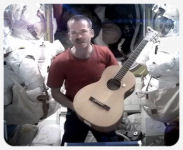 On Monday, three astronauts, Chris Hadfield, Tom Marshburn and Roman Romanenko returned from their half-year-stay on the International Space Station. While two of them were and still are Twitter users, it was especially Canadian Chris Hadfield who had really made internet history by not only sending daily images of earth from space, but also engaging in active social media outreach by filming videos, making music and giving lots and lots of interviews. His farewell gift from orbit, a wonderful cover version of David Bowie’s Space Oddity, has accumulated over 13 million views on the original Youtube video alone. What is even more amazing about his work is that he did it not as part of an orchestrated media campaign, but in his free time mostly all by himself and with the help of his son Evan.
It took a Canadian astronaut aboard the International Space Station to bring human spaceflight back into public awareness – not because he was told to, but because it was his personal choice. Chris Hadfield had actually been up in space two times before – in 1995 he flew with STS-74 to the russian space station Mir and six years later in 2001 he was part of the STS-100 mission to the new ISS, performing two spacewalks with his NASA colleague Scott Parazynski to install the Canadarm2 on the station. He was the first Canadian astronaut to walk in space – but these missions were only eight and eleven days long. His next spaceflight to his long-duration mission on the ISS came more than ten years later and gave him the opportunity to do what had not been possible before on his earlier missions due to time constraints – to share his incredible experience with the world. It’s fortunate that his time in space coincided with the emergence of social media, only five years ago all his efforts may not have been possible in this way.
Since the one half of Expedition 35 has come back to earth, there has been virtual radio silence to the public from the ISS. No more Twitter, Facebook or Google+ postings, no direct words from the astronauts themselves apart from a recent hangout with the actors of the new Star Trek movie. So why isn’t NASA stepping up to continue the wonderful outreach work of Chris Hadfield? There was a short artice in the Washington Post yesterday about this question and the answer was not altogether surprising: the NASA astronauts might not be allowed the same freedom Chris Hadfield has at the Canadian Space Agency, or at least they’re afraid that their activities in their free time might be seen as a misuse of government funds. With the sequester going on in Washington and NASA putting most of its education and outreach activities on the shelf, it’s completely understandable that most NASA personnel, maybe even including the astronauts themselves are not in a position to do much at the moment… but it’s a sad situation nevertheless.
But there is hope: both Karen L. Nyberg and Luca Parmitano, who are launching to the ISS on May 28th are active Twitter users and even now are busy tweeting about the launch preparations. And Chris Hadfield has also not gone silent after the landing – he is still reporting about his recovery process on earth and yesterday mentioned that he still has thousands of unreleased photos left which he is going to share daily. The adventure is still continuing…!

Later today, a group of three astronauts returns from the International Space Station, among them the amazing multi-talented Chris Hadfield, who has shared his experience in space through tweets and posts with photography, video and even music for the last six months. As a goodbye present, last night a wonderful music video of David Bowie’s Space Oddity was posted on Youtube with Chris Hadfield on vocals and guitar – and with video entirely shot on the space station! I actually had chosen something completely different for Music Monday, but I simply can’t resist posting this even if it’s already all over the web by now. Words fail me how completely and utterly amazing this is – it’s like real-life science fiction!
[Update 14.05.: The spacemen are safely back on earth! The NASA already has a great video summary from hatch closure to landing up on Youtube. News articles are all over the place, so I think I don’t need to write a seperate article. I may post something about the importance of Chris Hadfield’s phenomenal outreach work later or in the next days, though.]
 On Monday, Pamela Gay and Fraser Cain recorded the 300th episode of Astronomy Cast – an amazing and wonderful achievement of bringing scientific knowledge to just about everbody. They have been producing the podcast since September 2006 and have covered about every imaginable topic remotely connected to astronomy, but thanks to the scientific universe not being constant, there are still lots of new things to talk about and many older topics to revisit. Also amazing is that Astronomy Cast has spawned into a video podcast since the beginning of 2012 and every episode is recorded as a live hangout before it gets edited into an audio podcast, allowing the listeners to watch how the show is being made.
At the moment, there are 293 audio podcasts available on the website while editing is catching up with the actually recorded episodes. In addition, the latest 55 episodes are also available as video podcasts with an additional half hour where Pamela Gay and Fraser Cain answer questions from comments on the web. Shows 245-247 are available in this playlist (created by me), 248-300 are in the official playlist. The hangouts of the live recording usually happen every Monday at 21:00 CET and the best method to be notified when a hangout is coming is to circle +Astronomy Cast and +CosmoQuest on Google+.
So, why is Astronomy Cast so interesting? It’s not a dry and academic lecture, but the way Pamela Gay and Fraser Cain explain science is also not dumbed down at all, just enough simplified to make everything understandable for non-scientists. Some basic knowledge is, of course. required, as is at least some curiosity about the general subject itself, but their casual and friendly style makes the podcast very approachable, easy to listen to and often even really fun and entertaining. The sheer amount of episodes in the archive may be intimidating for first-time listeners, but the great variety of themes allows for a wide choice and while there is no need to listen to every single episode, I would neverteless recommend it.
So, happy anniversary, Astronomy Cast! May there be at least 300 more episodes in the future – you’ve been and will be an invaluable source of knowledge. Celebrate by listening or watching an episode or two, circle them on Google+ and leave them a nice comment!
