


 Two weeks ago, I posted a somewhat angry rant about what had transpired with the Google+ Android App on my tablet, but I think I have to write a kind of retraction as I already mentioned in an update of the original article. After things went really bad, they got a lot better – there were a couple of updates of the Google+ App in the last two weeks and the current version runs practically perfect now. Has Google really listened to the bug reports and fixed the fatal problem with the edit box? It seems so, because I can now post again without problems with the app and it seems it has become even faster than before. So, kudos to Google for making the Google+ app really useful again – I forgive them, they’re not perfect and make mistakes, but they are always relatively quick fixing them.
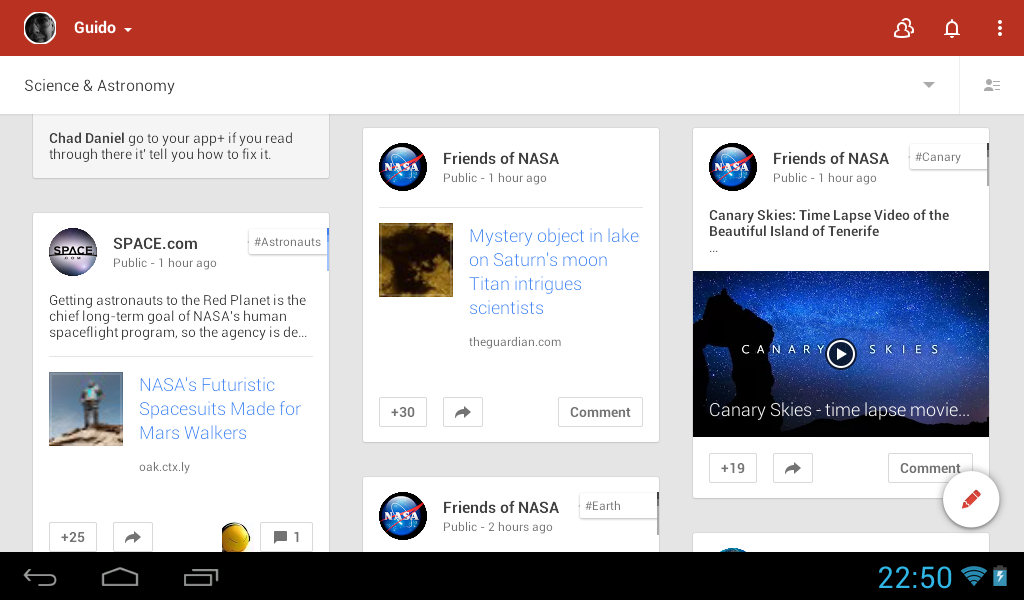
The Google+ App in action – the two top bars seem huge, but they scroll away if you swipe down!
(No, I actually don’t use the app in landscape mode all the time, it just fits the article better.)
There is still one aspect of the Android App and its mobile web counterpart that puzzles me, though: if you start a post from the main screen, you can choose a photo – but only from the highlights or local storage, not from your albums. For that, you have to go to the photo section of the app, choose the image and share it from there . This is not a very big deal, but surprisingly counter-intuitive to the openness of the app from which you should be able to access all of your Google+ content from everywhere. The exclusion of the Albums from the “quick share” option has been in the app from the beginning and seems like a glaring omission – this is, after all, a great tool for photographers who want to share their content and having to make a detour like this feels a little strange, especially because the option is there in the desktop version.
Apart from these slight imperfections, the Google+ App has improved so much over the last few months and using it even on a small 7″ tablet is extremely comfortable. Are there other improvements on the way? We’ll have to see – Wednesday and Thursday is the Google I/O conference and there are usually a lot of updates around the corner. It’s entirely possible that the web interface of Google+ gets revamped again like it happened last year. Stay tuned, and don’t panic if something looks different :-).

 It’s almost summer and that means there will be new radio shenanigans from Brian Cox and Robin Ince – their brilliant science-comedy radio show The Infinite Monkey Cage will return to the airwaves starting on July 7th via BBC Radio 4 and, as usual, also in the shape of freely available podcasts published on the series’ website in mp3 fomat. There are already 48 past episodes available plus a special from this March called Brian and Robin’s Infinite Inbox in which the duo answers some of the mail the show has been getting!
I can only highly recommend this show – Brian Cox and Robin ince are utterly funny and their guests are always fantastic. Besides, it’s even educational, despite most shows ending up somewhere completely different than they originally started – but that’s just the fun of it. As usual, major English listening skills and a healthy curiosity about science are required, but it’s actually quite easy to listen to. And, of course, if you like Brian Cox and/or Robin Ince, you’re in for a very special treat.(Note: I wrote the last paragraph for the previous post about the series, but why write something new when there’s something perfectly okay available to recycle?)

I think it’s time to put up these signs. Football, or Soccer as it’s known in America, is like Carnival: it’s a matter of taste and believe it or not, there are some people that don’t like it and other people who cannot understand it that some people don’t like it. That is why signs like these are unfortunately necessary. By all means have fun watching the games and cheering for your team, but do not expect me to partake in any of this. If you have use for these signs, you can download them as printable PDFs in both English and German versions. Thank you for reading :-).

 Last week, our nearly eight-year-old Canon Pixma iP4200 inkjet printer finally succumbed to a broken print head. Because it had a good run and a new head would cost almost as much as a new printer, we simply decided to get a new one. The requirements were an A4 photo printer with five single ink tanks and the capability to print on CDs and DVDs, making only one choice possible: the Canon Pixma iP7250, because it is currently the only non-multifunction printer from Canon with these exact characteristics. I did not even bother looking at other manufacturers because we had such a good experience with Canon, so the choice was actually very easy.
Continue reading »
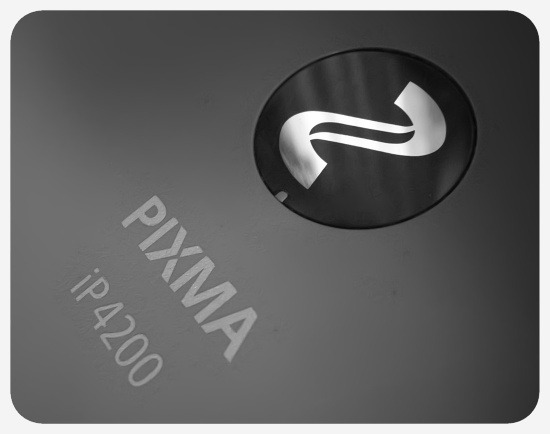 This week, our inkjet printer kicked the bucket – but it’s not really a bad thing, since the Canon Pixma iP4200 lasted almost eight years on a single print head and the same set of refilled ink cartridges. It was only our third inkjet printer and the fifth altogether, but the one that lasted the longest. Bought in August 2006, this printer has gone through thousands of pages of text and hundreds of photos, all in absolutely brilliant quality especially considering that it had originally cost less than 90 Euro. Actually just the print head is broken – the printer itself is still working, but since a replacement head would cost almost as much as a completely new printer, it’s now time to buy a new one now.
I can almost hear the cries, “Inkjet printing is terribly expensive!”, but that’s simply not true. While there are mechanisms in place that try to prevent refilling the ink tanks, they can be easily overridden on Canon printers so you can just re-use the original cartridges. There are no real ink level sensors on these tanks, the printer drivers just decide that ink tanks get empty after a certain amount of pages. This is why switching off this feature is absolutely no problem – after all, the ink tanks are transparent and you can always check how much ink is left by just opening the printer hood and pop out one of them to look at it.
Refill ink sets cost between 15 and 20 Euro for a set of five 20ml bottles of ink – I have been using the KMP RU5 set since the beginning and never had any problems with it. The refilling takes a bit of practice and is kind of messy, since you need to squirt the ink with a syringe into a hole you have to drill yourself into the top of the cartridge, but if you get used to it, you can refill all five cartridges in less than fifteen minutes. Each set of bottles is enough for about four refills, which is ridiculously cheap considering a complete set of original Canon cartridges costs about 50 Euro!
This is why our new printer is going to be another Canon – the Pixma iP7250 to be specific. Originally, we wanted to buy it in our local electronics store, but guess which printer was the only one they didn’t have in stock anymore? This is exactly why we do our electronics shopping mostly online nowadays. If the local stores can’t keep up then I’m sorry, but I had to order the printer from Amazon anyway and it’s probably going to arrive tomorrow or on Monday.
The good news is that it’s going to cost only about 80 Euro – hopefully it will last as long as its predecessor, who is not going to be put away, but into storage as backup and in case I can find a replacement print head one day that does not cost as much as a new printer. But I’m excited about the new printer – it has more resolution and even WiFi, which will come in very handy as a network print server. Maybe I will do a little product review, but done right this could take some time – nevertheless, stay tuned for more printer shenanigans and maybe an article about our printer history all the way back to the late eighties with the dot-matrix noisemakers :-).
Warning, this is a bit of a rant and the reason why I didn’t post as many photos today as usual… Recently, the Google+ Android App got a big update with some interesting and useful design changes and a lot of improvements under the hood, which meant that for the first time the app didn’t slow down my whole tablet to a crawl. Reading, posting comments, even the problematic browsing of my own photo galleries works perfectly and I seemed to have a completely new tablet because everything else became lightening fast.
But today, I actually tried to post something and my tablet locked up to the point that I had to make a hard reset – the pin-in-hole kind. On the next reboot, the whole tablet was extremely slow, probably because the crash had damaged the database of the G+ app. It took me almost two hours to deinstall the app and then I also had to deinstall Chrome and Hangouts because they also slowed up the device. After reinstalling the three, everything worked fine again. And then I tried to post again and exactly the same thing happened. At the moment I’m on round three and have come to the conclusion that it’s pointless: the sharing/writing component of the Google+ app simply breaks my tablet.
This should not happen on a device which I just bought last year – it’s by no means a high-end tablet, but Android 4.1.1 on an 1.6 GHz dual-core cpu with 1 GB RAM should really be enough to run the Google+ app, which works absolutely fine until you want to actually post something. Interestingly, on my older tablet which only has a 1.2 GHz single-core processor and 512 MB RAM, the share/edit box does not crash, so I fear that this whole thing is a bad bug only happening on certain devices. The problematic thing is that I cannot even file a proper bug report because the tablet even crashes doing that! This is all extremely frustrating to the point that I just want to give up.
Option A would be going back to the older version, which is not really acceptable because it slows down my whole tablet and needs constant cache-clearing to keep it working. Posting, with a lot of patience, works though, but it’s hardly worth the effort.
Option B would be keeping the new version for reading and commenting, but not posting. This would mean that I would only be able to post via the WordPress Publicize feature to Google+, and that means especially for posting photos that I won’t be able to post full-size images to Google+ any more. I am seriously considering this for the hot days when I can’t use the laptop much over the day, although I might post the full-size photos later.
Option C would be for Google to fix this bug!! I don’t want to complain about something that’s free, but I’m really frustrated at this point of having the possibility to do everything comfortably from the tablet, but being prevented by buggy software from it. Come on, Google – you’re better than this! The G+ app is the best thing out there and should not suffer from bugs like this.
Option D only occurred to me the next morning – why not use the G+ mobile website? To my surprise, the mobile website now hast about 90% of the features of the app and getting to my albums to post photos certainly seems no problem. And because I’m already in the mobile web browser using WordPress I would not even need to switch apps, only tabs. I’ll be testing this later today.
The bottom line is, I don’t have anything against Google+ and actually love the Android app especially in the new version, but if such a bug prevents me from sharing content from my mobile device, what can I say? Please fix this problem, Google!
In the unlikely event anyone from Google actually reads this post, my tablet is an Odys Genio running Android 4.1.1 on a 1.6 GHz dual-core Rockchip RK3066 processor with 1 GB RAM and 8 GB flash, not rooted or anyhow else modified from the factory version.
[Update June 17th: It seems like the recent version 4.4.2.68956353 from June 13th has fixed the crash on the posting box, at least on my tablet. Did someone from Google really listen to my bug reports or was that just coincidence? I have no idea! I’m going to write another post soon about this issue.]
 Tomorrow evening, a new group of astronauts will be launching into space to the International Space Station from the Baikonur Cosmodrome in Kasachstan. The second part of Expedition 40 will be the American Reid Wiseman, the Russian Maxim Surayev and the German Alexander Gerst – a truly international crew of three countries who may be at odds in the political world, but in space this does not matter at all.
Tomorrow’s Soyuz launch will be at 21:56 CEST or 7:56pm UTC, with the docking scheduled for 04:14 CEST or 02:14am UTC. There is also going to be a special ESA post-launch hangout with Luca Parmitano from the Columbus control center at 22:30 CEST or 10:30pm UTC!
[Update 28.05.: The launch was a success! The three astronauts are in orbit and now have to catch up with the space station. Hopefully they can take the quick route and dock in six hours!]
[Update 29.05.: And they really did it in under six hours! Here are videos from the liftoff, the docking and the hatch opening and welcome ceremony. Now the real work and science begins!]
The mission of Alexander Gerst is, of course, of special interest to us since he is only the third German astronaut to visit the space station after Hans Schlegel and Thomas Reiter and only the second one on a long-term mission – but he is more an European to me in the same group as all other ESA astronauts. I especially love that Gerst has chosen to call his mission Blue Dot after the famous Voyager image and Carl Sagan’s subsequent description of it. I won’t even begin to write about the details of the mission, because today the ESA has uploaded a wonderful 40-page brochure about it, available in both English and German with a lot of information not only about Gerst, but the whole spaceflight experience to the ISS. It’s very well-written and has a lot of amazing photos and graphics, making it very much worth downloading and reading.
Alexander Gerst is also taking a mouse with him to space – an orange plush one, the mascot of the popular German children’s television show Die Sendung mit der Maus. It’s not the first spaceflight of the Maus – it had been on Mir in 1992 when German Astronaut Klaus-Dietrich Flade had taken it on a short visit and even filmed a segment for the program. Alexander Gerst has already appeared in Sunday’s broadcast, which you can still watch in a recording in the ARD Mediathek (in German of course). During his stay in space, he will be answering questions from children on the Maus Website which will probably get read out in the program – there is no word yet if he will be doing video recordings for them or even a live linkup, but maybe something will happen. I love this especially because Die Sendung mit der Maus was a part of my own childhood – the program originally began in 1971 and is older than me!
While he has an official blog on the ESA website, Alexander Gerst is also very active on Twitter as @Astro_Alex, where he has been constantly reporting about his preparations for his first spaceflight and has been posting a lot of photos recently. He is joined by Reid Wiseman at @Astro_Reid and, as I only found out yesterday, by Maksim Surayev at @MSuraev! The cosmonaut just started tweeting again a short while ago and is only posting in Russian – but this should not be a problem with online translation. [Update 31.05.: I keep finding more Russian astronauts on Twitter – Oleg Artemyev, who arrived on the station in March is also tweeting as @OlegMKS!]
The three astronauts of the prime crew have been actively supported by their backups, who will be going to space in November, Samantha Cristoforetti, Anton Shkaplerov and Terry Wirts with both Cristoforetti and Wirts posting many amazing photos from Baikonur on their Twitter streams @AstroSamantha and @AstroTerry. [Update: Shkaplerov is also on Twitter as @AntonAstrey, although he isn’t very active and mostly retweeting from his crewmates.] Cristoforetti is also still actively writing her Logbook on Google+ about her own preparations for her first spaceflght and two weeks ago she did a great ESA Hangout answering questions from all over the world!
If you want to follow all the astronauts on Twitter, I’m still maintaining and updating my Astronaut Twitter List – if you know of any astronauts or cosmonauts I don’t have in there, please don’t hesitate to tell me! With all the great social media involvement, the next year or so is certainly going to be amazing regarding all things spaceflight.



This year, for a change, I have not forgotten that it’s Towel Day today, the annual celebration of all things Douglas Adams and Hitchhiker’s Guide to the Galaxy. This time around, I managed to throw together a couple of things – head over to DVDLog to read the painstakingly translated review of the 1981 Hitchhiker’s Guide to the Galaxy televisison series, which was actually a lot of fun to revisit and update, because it’s not only a disc review, but partly the history of the Hitchhiker’s Guide itself. I originally wanted to make this a double review together with the 2005 movie, but that has to wait until next week or so because writing the translation took a bit longer than I expected!
Back in March, it seems I missed something great – the cast of the Hitchhiker’s Guide Radio Series had been on tour with a live show, but this spring there was a 75-minute live radio broadcast on BBC4 from the whole gang. And of course it’s now off the iPlayer and I haven’t found a recording of it yet – but hopefully it will materialize somewhere!
Meanwhile I’ve been poking around Youtube and there are some great Douglas Adams treasures out there, which I have put together in a little playlist. There are several great documentaries and even the rare South Bank show which I originally saw in dubbed version somewhen in the early 1990s on German television. You can actually find the television series itself somewhere if you search for it, but I’m not linking to it because the Youtube uploads have a really bad image quality compared to the DVD and, of course, because of copyright reasons. Buy the DVD! It’s not like it still costs 30 bucks like it did twelve years ago.
And there’s something which Douglas Adams would have really liked: ISS Expedition 42 is wishing everybody a happy Towel Day! Samantha Cristoforetti, Terry Wirts and Anton Shklaperov are standing here holding a towel in front of the very Soyuz capsule which will bring Maksim Surayev, Alexander Gerst and Reid Wiseman to the ISS in only three days – they are the backup crew and are currently together with them in Baikonur.
Have I forgotten something? Maybe, but I can just add it later here in a sneaky after-publishing-edit – I already added the previous paragraph shortly before posting. Happy Towel Day everyone! :-)
 Tonight, another mission to the International Space Station comes to an end and a new one with the round number 40 starts when Rick Mastracchio, Koichi Wakata and Mikhail Tyurin return to Earth and temporarily reduce the crew to only three people instead of the usual six. NASA Television will as usual broadcast everything with the undocking happening at 00:15 CEST.
The astronauts are already strapped in and the hatch to the Soyuz capsule has been closed now for a while. Mastracchio and Wakata have already sent goodbye tweets, but the American astronaut has already promised “post-flight fun” and handed the Twitter baton over to Alexander Gerst and Reid Wiseman, who are already reporting a lot about the preparations for their May 28th launch together with their Roscosmos colleague Maksim Surayev – no Twitter link here, since the Russian astronauts are sadly not doing any social media. Scratch that! I’ve since found out that Surayev does in fact regularly tweet as @Msuraev, but he writes in Russian, which is thanks to online translators not a big problem.
[Update: The astronauts are safely back on earth, everything went as smooth as a bumpy, rattling Soyuz re-entry can be. The NASA TV Youtube Channel has a long video from the landing site operations – the capsule actually landed upright and the astronauts had to be pulled out through the top with the help of a mobile gantry. This hasn’t happened for a long time, usually the capsules land on the side.]
With the departure of Mastraccio and Wakata, there is a sort of social media outage on the ISS at the moment, because the only American astronaut Steven Swanson does not have a Twitter account, but there is at least the official Instagram ISS stream, where occasionally photos from orbit get posted. But that will only last until the next three astronauts go up.
Meanwhile, the future of the ISS seems once again in limbo – originally, the Space Station was supposed to stay at least another decade, but now Russian officials are rattling their sabers and saying that they want to give up the cooperation in 2020. As a rule, I won’t comment on the political reasons, but as this comes not from Roscosmos, but Russian deputy prime minister Dmitry Rogozin, this is nothing more than playing politics with spaceflight and science, which is a really sad and stupid situation.
I’ve been watching the new ISS Earth live stream for over a week, but it seems that only now the mainstream press seems to have really noticed it, although Universe Today and a couple of other space-themed media outlets reported the news around May 1st. There seems to be a little confusion about the cameras – this is not the commercial UrtheCast system, which is still in closed beta, but a separate NASA project called the HDEV or High Definition Earth Viewing Experiment. Four different comercially available HD cameras have been put in a climate controlled, but basically otherwise unshielded housing and installed outside the ISS. One camera is looking forward, one down and two aft. The whole unit does not record anything on the station, but directly downlinks its stream to Earth.

While the stream is publicly available over the UStream website, the main reason for this project is to test how modern video cameras are fairing in space. Some parts of the systems were designed by high school students through the NASA Hunch program and student teams are also responsible for the operation of the cameras. One thing to remember when watching the stream is that it is really an experiment – the cameras are fixed and do not have any zoom or panning capability, but switch their views automatically. Of course, there is nothing to see when the ISS is flying over the night side of the earth because the cameras are not light-sensitive enough, but the sunsets and sunrises can be spectacular like in the screenshot above. The broadcast also sometimes has gaps because the bandwith-intensive video connection does not cover the entire globe – just wait a little when a grey screen is shown until the image comes back.
I recommend having a look at the ISSTracker website or the excellent Orbitron program to find out where the ISS currently is – there is hardly a delay in the broadcast so that the orbit indicator is very accurate and can help predict when the station is on the night side of the planet. The bottom line is simply that the views are absolutely gorgeous and while there has been live streaming from the ISS before, this is the very first time that live video from the space station is available in really good quality. Welcome to the future :-).
