


 I’d like to wish all family, friends, regular readers, commenters and all other visitors Happy Holidays, Merry Christmas, A Happy New Year or any other holiday greetings you prefer! Myself, I like Happy Newtonmas because Isaac Newton was born on December 25th, but I’m very democratic in that respect and let everyone celebrate the the holiday you prefer.
Last year I basically skipped the year-end retrospective I usually write at this point because I wasn’t feeling very well, but this year I’m a lot better and I’ll do at least a little roundup. Let’s just say that 2014 was a lot better than 2013 – it has been very busy and while I only got around to do a fraction of what I had originally planned to do with the websites, it’s been a lot of fun and especially the interaction over the social networks has reached a whole new dimension.
The Photography Blog, now renamed at least temporarily to GB Photography to give it a proper name, is actually the only one of the three websites I’m regularly active on at the moment. I usually post several photos per day, mainly because I built up such a huge backlog especially of flower photos that I have still enough to go even if I don’t take another photo for weeks. But that’s not going to happen, because I finally managed to snag a new camera on Ebay in November – I wanted a little upgrade ever since I found out in Spring that the camera I bought the previous year has some lens sharpness issues. Next year is going to be even better with the photography and maybe I’ll finally get around to redesign the photography blog and the galleries. But posting the photos on Google+ has been almost as important, because the feedback there has been absolutely phenomenal and the photography community is amazing to say the least.
In contrast to the photography, the movie and DVD reviewing over on DVDLog has been on a bit of a backburner this year, mostly because there was not so much to write about and I didn’t get around to do as many translations of older reviews as I wanted. But I did get some reviews done including a television five-parter in the fall about Brian Cox’ new series – and I still have a couple of unreviewed discs lying around which I will get to next year. I have to admit that I really can’t keep the one-review-per-week rhythm up any longer, but I will try do get the site going more next year. I’ve also finished switching over everything into English including a new review index, but there is still a triple digit amount of great material to be properly translated – so this site will never die and I’ve never really thought about shutting it down. Just be patient, once in a while I will have something interesting.
This Blog here has also been subject of a slow transformation – it’s still my go-to outlet for everything that is not related to photography, movies and television, but the focus has been mainly on science and astronomy in 2014 because so much exciting things have happened. I usually leave the science reporting to the real reporters, but some things I just had to write about and I’ve made a kind of series out of the postings about the comings and goings on the International Space Station. I have also been very busy supporting CosmoQuest and there is also the Hangouts Schedule which I’ve kept updated ever since August – this will get a slight makeover and a move to a proper page in the new year. I’m also considering moving the whole site to the spiffy new bibra.eu domain I registered this year and there’s also the small, but important matter of making the theme compatible for mobile devices, but I will come to that when I really have some time.
As usual, I will not go completely offline over the holidays, but instead put DVDLog on a winter hiatus until February and slow down the Photo Blog a little bit to maybe two posts per day plus perhaps some collected galleries. Between Christmas and the new year I’ll maybe share some of my circles over on Google+ again like I did last year and then put them in a blog post – it’s certainly time for an update! But other than that, I’ll take a well deserved break and will not be much online until early next year.
Wishing everyone a nice and relaxing winter holiday – see you in 2015!

 I seem to be writing a lot about spaceflight and space exploration here at the moment, but that’s mainly because there are so many exciting things happening at once right now. Tomorrow there’s going to be another premiere in spaceflight: NASA is going to launch its Orion Spacecraft for the first time in a test flight! So, why is this so exciting if everyone is already flying to space all the time? Mainly because it is the first human-rated spacecraft commissioned directly by NASA since the Space Shuttle and it has quite a history behind it that reaches back more than a decade.
Originally a part of the Constellation program that had been developed under the US Bush administration since 2004 and was subsequently cancelled in 2011 to be replaced by the Space Launch System and the Orion Multi-Purpose Crew Vehicle, the basic concept actually goes back all the way to the late 1960s. Launched on top of a multi-stage rocket, the spacecraft consists of a command and service module exactly like the Apollo missions, with only the command module returning to earth. The now completed Orion Crew Module is being built by Lockeed-Martin and the subject of Thursday’s test flight, while the actual Orion Service Module is still in development and will be built by ESA and Airbus on the basis of the ATV transporter, launching in 2017 or 2018 on the Exploration Mission 1 on a flight all the way around the Moon.
But first, the Exploration Flight Test 1 has to bring the Orion Spaceship into orbit, two times around the Earth and then land safely again. This is going to happen tomorrow, December 4th, from about 12:00 to 16:30 UTC – Jason Davis from the Planetary Society has compiled a detailed flight timeline derived from the press kit, which will be very handy to coordinate your day if you want to watch the launch on NASA TV or follow what’s happening around the web. Although this is still an early, uncrewed test flight without the complete spacecraft configuration on top of a Delta IV Heavy rocket supplied by United Launch Alliance instead of the still in development SLS, the importance of this first step should not be underestimated – everything has to start somewhere! Speaking of starting, or launching – NASA has replaced the famous countdown clock at the Kennedy Space Center with an updated version just in time for the Orion launch. This was mainly done because it was too hard to find replacement parts for the old clock, which had been in place since Apollo 12 – and the new clock actually looks very nice.
[Update 12/4: First it was a boat in the launch range, then the wind and finally a problem with some valves on the rocket that prevented today’s launch… but it appears that there will be another attempt tomorrow!]
[Update 12/5: Today’s launch was succcessful on the first attempt without any problems! Orion is currently in Earth orbit, but the mission is not over yet with the second boost for the higher orbit still coming. Unfortunately, there were some massive problems with the NASA TV online streams – the UStream channel went offline right before launch and NASA’s own stream only buffered like crazy, so many people weren’t actually able to watch the launch itself live. At the moment everything’s watchable again, though and there’s already a video of the launch on Youtube!]
[Update 12/5, 6pm: Splashdown! After a picture-perfect flight, the Orion spaceship has returned to earth and is currently floating peacefully in the Pacific near the Californian coast waiting for recovery! Videos from the flight will probably be up soon on the NASA Youtube channel. (Actually, the NASAKennedy channel has some videos this time, including the amazing splashdown!)]
Last, but not least, there is a little bit of irony in naming the spacecraft Orion, because 48 years ago, even before the first Apollo flight, the Spaceship Orion launched on German television screens! With a predecessor like that, the “new” Orion will surely be a great success, although most of the press just seem to be interested in the costs and even say the launch is overshadowed by the recent failure of the Orbital Sciences Antares rocket and the crash of Virgin Galactic’s SpaceShipTwo – which, as usual, is absolute nonsense and a really irresponsible thing to say.
And in somewhat related news, the next comet investigator Hayabusa 2 has launched earlier today. It’s a cooperation between Japan, Germany and France and will arrive in four years at an asteroid to collect samples and even drop a small lander (which is the German-French contribution) on it, basically Rosetta-Philae style. But that’s all still four years and more in the future – stay tuned, more about this in 2018!
 I already posted the November edition of Shift Change in Space at the beginning of the month, but yesterdays Soyuz launch to the International Space Station was so amazing that it warrants at least a little article of its own. The absolutely flawless launch from Baikonur and the later docking was so well-timed that there was an uninterrupted video stream throughout, showing especially the rendezvous with the station like it had rarely been seen before – with amazing views from both the station’s and the Soyuz’ cameras broadcast live from space. Fascinating highlights – like the Soyuz bathed in a golden glow from the setting sun – are already available of the launch, the docking and the wonderful welcoming ceremony on Youtube.
The three new stations occupants Samantha Cristoforetti, Anton Shkaplerov and Terry W. Virts already seem to be quite at home in their new environments, but there have, of course, been no tweets or other social media posts from them – yet! All three of them are on Twitter (click on the link for my now updated list of tweeting Astronauts in space!) and Samantha Cristoforetti had been writing her Logbook on Google+ almost until shortly before launch – and she already mentioned that she will begin chronicling her Futura mission in exactly the same way as soon as possible. [Update 11/25 – which she did with a first posting from orbit!]
The media’s reaction was, as usual, mainly lukewarm and not really interested – if it wasn’t for the fact that the Soyuz is also carrying a zero-g capable espresso machine called ISSpresso. The machine was developed by Lavazza and the italian company Argotec, which had already supplied food for the missions of Luca Parmitano and Alexander Gerst before, which is certainly interesting – but suddenly only the espresso and the kilo of caviar this launch also seems to be carrying are all over the press. [Edit: only the Guardian does it right by publishing an interesting in-depth article about the ISSPresso!] This already led to silly comments that there is too much luxury abroad the space station and that this is supposedly wasted taxpayer money – but who else can make space travel more comfortable with good food and drink if not the astronauts themselves? This is part of scientific research like everything else, which unfortunately gets mentioned not nearly often enough.
There is also the somewhat belittled fact that Samantha Cristoforetti is the first female Italian astronaut going to the ISS, which should be really important and a completely normal at the same time. This time she also joins Yelena Serova, making the crew of the station 2/3rds female for the first time since Expedition 24 in 2010, when NASA astronauts Tracy Caldwell Dyson and Shannon Walker were part of the station’s crew. I shudder at the thought what the press would make of the fact that Cristoforetti and Serova are both on their first spaceflight, while Barry Wilmore, Terry Virts, Aleksandr Samokutyayev and Anton Shkaplerov are all on their second flight… but hopefully nobody is going there except to mention that the two women on the station are spaceflight pioneers in the best sense of the word.
I think Expedition 42 is going to be amazing, whatever the press is going to make of it. Social media is playing a huge role in popularizing and supporting space space travel, and with the three new arrivals on the station it’s only going to be more interesting and fascinating.
 Comets have been visited by scientific spacecraft for a long time, but what is going to happen tomorrow will be something that has never been attempted before: to actually make a soft landing on a comet’s nucleus. ESA‘s Rosetta Spacecraft has already been orbiting Comet 67P/Churyumov-Gerasimenko (better known as Churry-Gerry) since August after a ten-year-journey and on Wednesday, November 12th, its Philae Lander will hopefully set down on the comet shortly after 5pm CET. I’m not going to write much more about the mission here because there are better articles about it everywhere else, but instead I want to give just a few tips how to follow tomorrow’s events.
• Both NASA and ESA will provide live video from the event, with the ESA Livestream having already started today on 20:00 CET for 24 hours and NASA TV providing occasional coverage. The ESA stream has also been embedded on the Rosetta Homepage now.
• Emily Lakdawalla from the Planetary Society is in Darmstadt at the ESA control center to cover the landing. She has already posted her immensly detailed Landing Timeline which really has all the information about what will be going on. She has also filed a first report this morning with fresh information about Phlilae’s status and much more. To follow her, the best spot are her Blog at the Planetary Society and her Twitter Feed.
• Emily has also put together a Twitter List with officially designated Rosetta/Philae Tweeters for all the up-to-date information which is very worth following and subscribing to.
• Nicole Gugliucci and Georgia Bracey from CosmoQuest are going to dedicate tomorrow’s episode of the Learning Space Hangout to the hopefully successful comet landing. The hangout starts at 8pm CET, about three hours after the landing. The Weekly Space Hangout on Friday is also probably going to have a lot to talk about Rosetta.
This is basically everything really important – I’ll update this post sometime tomorrow according to what happens, but everything else is now up to the two spacecraft themselves and the engineers behind them. Good luck Rosetta and Philae!
[Quick Update: PHILAE HAS LANDED! Almost right on time the news came that the lander had made it to the comet’s surface. There are some concerns about stability, because the harpoons don’t seem to have fired, but the scientists are very optimistic and the lander is certainly working and returning data. For more news, see the above links!]
[Update 11/13: First surface images from the comet! Philae’s landing didn’t go all according to plan, because the lander actually bounced two times after the first ground contact and the final location seems to be in the shadow of a crater rim, but considering the circumstances this is still a phenomenal success. The latest press conference from today had a lot of detailed information especially about the newly released images.]
[Update 11/16: Because it finally landed in the shadow of a crater rim, the (first) life of Philae was unfortunately too short, but a lot of amazing science data was collected. I recommend reading Emily Lakdawalla’s last post about witnessing the remaining time before the lander went to sleep. There is a chance that the plucky little lander will wake up again, but for now there is still the Rosetta spacecraft itself orbiting the comet, which is actually the main part of the mission!]
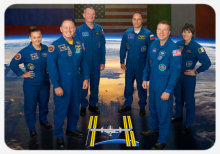 It’s not so long ago that I wrote a previous version of this post, but this time I’m determined to write regular followups like this one. Tomorrow, the first half of Expedition 41 to the International Space Station, is coming home after almost six months in space and the station’s crew will be temporarily reduced to three astronauts before the next crew is launching soon and Expedition 42 is going to start. I just like to keep an overview on the crew changes on the space station and this time it’s going to be very interesting!
Continue reading »
 On Tuesday, the failure of Orbital Science’s Antares rocket with the Cygnus space cargo freighter was a harsh blow to space exploration, but on Friday even worse news came with the breakup and crash of Virgin Galactic’s SpaceShipTwo during a test flight, resulting in the death of one pilot and serious injuries to another. Both accidents combined are maybe the worst event in spaceflight history since the loss of Space Shuttle Columbia eleven years ago, but unfortunately many people are already jumping to all the wrong conclusions.
Continue reading »
 Launching rockets into outer space has never been easy – there’s a reason it’s called rocket science. Occasionally things go wrong, often in testing, sometimes on actual launches. Rockets may misbehave by not going where they should go or even refuse to work altogether and simply blow up – that’s their nature and that’s what happened yesterday with Orbital Science’s third cargo flight to the International Space Station. The Antares rocket, all 40 meters of it, first appeared to launch normally, but then there was an explosion at the rocket’s business end only a couple of seconds into the flight. It was followed by an even bigger explosion when it crashed back to earth in a spectacular, but also rather terrifying fireball.
Continue reading »
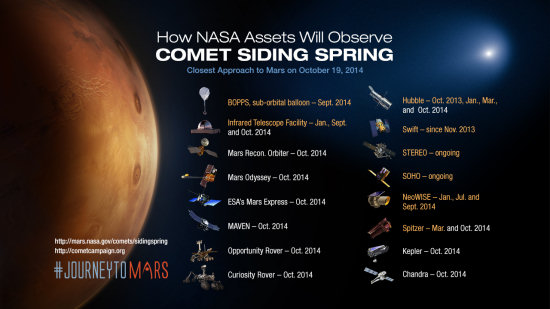
It’s finally happening, but it seems like ages since Comet C/2013 A1 “Siding Springs” was discovered last year and everyone was very excited at first because it looked like it would actually collide with Mars. Fortunately, if turned out that the comet is only making a close flyby of the red planet, but this is going to be spectacular nevertheless. With a whole fleet of scientific probes around and even on Mars, humanity is still going to have a front seat without being too near the action. The whole spectacle starts at about 18:30 UTC in less than four hours and while we probably won’t see any images from the orbiters and rovers right away, we can still observe the comet’s encounter here from earth. Here are a few pointers with all the necessary information:
• Emily Lakdawalls’s post basically has all the links, including several online observatories which will be broadcasting later. It’s also recommended to follow her on Twitter at @elakdawalla because she will probably be live-tweeting the event.
• Universe Today has several articles up, but this one by David Dickinson from a couple of days ago is especially interesting because it describes how the comet encounter actually looks from the surface of Mars – hint: it’s enormeous!
• If you want to populate your Twitter feed with science, you can subscribe to my Science & Astronomy list and maybe in addition also to the Spaceflight list.
• NASA also has a lot of information on their website, including the infographic what is observing when at Mars during the comet’s flyby.
[Update 20.10.: All three NASA Mars orbiters are fine and the newest arrival, India’s MOM also seems to be okay. Now we just have to wait for news on observations – no new images yet from the orbiters and rovers, but that will probably come in the next few days when all the images have been downlinked. (It appears one image already has made its way to Earth!) And you can always check on Deep Space Network Now what the different radio telescopes in the interplanetary WiFi are doing!]

 Because I haven’t been posting here much, here’s just a quick reminder that I’ve been constantly updating the Science & Astronomy Hangouts Schedule on the original post from August and lonks to many previous hangouts are still archived there. You can also join the WSH Crew Google+ Community (named for the Weekly Space Hangout) where this post is also available plus a Google Calendar which we keep updated with all the interesting hangouts.
The WSH Crew Community has been growing a lot recently and if you’re interested what’s new in space and astronomy you might feel right at home there. It’s much smaller than the big Space Community on Google+ and relatively low-noise, but filled with a great group of people who have been following and supporting what CosmoQuest, Universe Today & Co are doing for a long time. Some of the journalists and scientists involved in the Weekly Space Hangout have also joined and recently hangout organizer and host Fraser Cain has asked the community to contribute news stories to the hangout by posting them in the news section. This has been really popular and successful in the last couple of hangouts, making themeven more lively than usual in the last half. So you can join in and be a part of it if you want!
 I like to keep tabs on who’s coming and going on the currently only human outpost in space, the International Space Station. Like every Spring and Autumn, it’s again time for crew changeovers with several of the half-year missions overlapping and ensuring that there are at least three, normally six but sometimes even nine astronauts on the station. Right now, there are only three up there, but tomorrow’s Soyuz launch will bring the crew contigent back up to six – and this expedition and the one that will be following it in November will be very special ones indeed. Let’s see who is coming, who is going and what other space traffic is in the vicinity of the ISS. [Image: Crew photo of Expedition 41]
Continue reading »
